Page Contents
- What Is A Conveyance Deed?
- Understanding Conveyance Deed Meaning
- Why Is Conveyance Deed Important???
- Key Differences Between Sales Deed & Conveyance Deed
- Conveyance Deed For Societies
- What Are The Types Of Deed Of Conveyance?
- What’s Included In The Deed Of Conveyance?
- Important Documents Required For The Conveyance Deed
- Sample Conveyance Deed Format
- FAQs
What Is A Conveyance Deed?
A conveyance deed is an important legal document for transferring the ownership of the property. It is necessary for transferring the ownership of the property by sale, gift, or exchange.
The ownership of the property is only valid after the registration of the conveyance deed with the sub-registrar’s office. It can be registered by paying the stamp duty and registration fees.
As of 2026, almost every state in India provides a lot of online payment and digital registration options, and the earlier mentioned “provision” of registering online has now been made mandatory for most transactions (in terms of this process and the portal, which vary by state).
Digital Registration Update (2026)
- Nationwide E-Stamping: Stamp duty on property documents,?? including conveyance deeds, sale deeds, and gift deeds, is increasingly paid through e-stamping, administered by the Stock Holding Corporation of India Limited (SHCIL) as the Central Record Keeping Agency, or through equivalent state-run portals (e.g., GRAS in Maharashtra, eSampada in Karnataka, GARVI in Gujarat). Each e-stamp carries a Unique Identification Number (UIN) that can be verified online.
- Registration Bill 2025: The Union government has forwarded a draft Registration Bill, 2025, to replace the Registration Act, 1908, which has been in force for more than a century. It aims to introduce comprehensive online submission, verification, and registration of real estate-related documents, such as sale deeds and agreements to sell, as well as Aadhaar/PAN-based authentication among the multiple methods of verification. This is still a proposed central framework at mid-2026, and individual States are still using their state registration processes in the meantime, so purchasers should check with their state for the relevant process.
- State-level Digitisation: Several states have separately rolled out their own e-registration upgrades, digital KYC, biometric verification, and online appointment/slot booking at sub-registrar offices, ahead of any central rollout. The exact features (fully remote registration vs. partial digitisation) differ significantly by state.
- Digital certificates: Wherever e-stamping applies, the resulting e-stamp certificate / UIN is now a standard reference to include on the registered instrument, alongside the traditional stamp paper details in states that still use them for certain document types.
Understanding Conveyance Deed Meaning

Let???s understand the meaning of the conveyance deed by analysing both the terms separately.??
In the real estate domain, Conveyance means transferring the ownership of the property. The transfer of the property can be by selling, gifting, or exchanging the property with another party. Now, this conveyance, or transferring the property from seller to buyer, takes place through a specific instrument or deed.
The Deed is the legal document that includes the terms and conditions involved in the property transfer transaction. The parties involved in the property right transfer need to sign the deed after duly reading the terms and conditions.??
To put it simply, the conveyance is the process of transferring the property, and the Deed is a legal document comprising the terms and conditions of the property transfer.??
Execution, or the signing of the conveyance deed and registering it at the sub-registrar office, successfully transfers the ownership of the property.
Why Is Conveyance Deed Important???

In any property-related transaction, a Conveyance Deed is crucial for the following reasons:
- Conveyance Deed is the legal proof of property ownership
- Conveyance Deed is required for a home loan application
- It can be produced in front of courts as legal proof of the property
- It validates and completes the property transfer process from seller to buyer or in case of gift and exchange
- It gives the complete details of the property transaction process
- In 2026, a digitally verifiable conveyance deed backed by an e-stamp certificate/UIN and, where available, online document search facilities also makes title verification faster for buyers, lenders & legal professionals
Key Differences Between Sales Deed & Conveyance Deed
Mostly, the terms conveyance deed and sales deed are used for property transactions.
There are some key differences between the Sales Deed and the Conveyance Deed, which are mentioned below:
| Conveyance Deed | Sales Deed |
| A conveyance deed is a legal document for transferring the property from one party to the other. The conveyance could be for a property sale, gifting, or exchange. | A sales deed is a type of conveyance deed used for selling the property from one party to the other. |
| The conveyance deed may or may not give complete ownership to the property buyer. | A sales deed gives complete ownership of the property to the buyer. |
| In a conveyance deed, the property buyer has the right to use the property, but may or may not have the right to sell it. | In the sales deed, the property buyer or the owner has the right to use and resell the property. |
| In the case of the conveyance deed, the property ownership is transferred completely or for a certain period of time. | In the case of a sales deed, the property ownership is transferred completely and permanently to the buyer. |
| Stamp Duty and Registration Charges may or may not be applicable on the Conveyance Deed registration. | Stamp Duty and Registration Charges are applicable and mandatory for registering the sales deed. |
Conveyance Deed For Societies
The developer owns the land or the plot of the real estate project. After the construction of the project, the developer sells the apartments to the property buyers.??
While selling the property, the developer and the property buyer execute the Sale Deed, which gives property rights in the constructed part, and the ownership of the land still remains with the developer.??
To give complete ownership of the land, the developer and the society should execute the conveyance deed.
Deemed Conveyance & RERA Integration
In case of failure or refusal of the developer to transfer the land title to the society within the statutory period (Presently under MOFA/MahaRERA for 4 months from the formation of the society):
- Online Deemed Conveyance Portal: The housing society will be able to submit the Deemed Conveyance application on the Deputy District Registrar (DDR) portal online.
- Unilateral Order: After reviewing submitted documents (RERA occupancy details, layout plans, and member lists) and holding hearings, the DDR issues a Deemed Conveyance Order.
- Digital Land Record Update: This allows the society to unilaterally register the conveyance deed and update the property card/revenue records without requiring developer sign-off.
What Are The Types Of Deed Of Conveyance?
The deed of conveyance can be classified as follows:
- Conveyance Deed On Freehold Property
The conveyance deed on the freehold property gives the complete ownership rights to the property buyer.
- Conveyance Deed On Leasehold Property
The conveyance deed on the leasehold property means that the property owner has the right only to the construction and not to the land.
- Gift Deed
The conveyance deed can also be done for property that is gifted from one party to the owner.
What’s Included In The Deed Of Conveyance?
The deed of conveyance has the following things:
- The details of the parties involved
- Property-related details and specifications
- Power of attorney, if applicable
- Complete definition and details on the boundary of the property
- All the legal property rights of the owner
- All the Important terms and conditions related to the property ownership
- Tenure of the property ownership
- Names and signatures of the witnesses
- e-Stamp certificate number / UIN from the applicable e-stamping portal??
- Digital land record/property card reference number, where the state maintains one
Important Documents Required For The Conveyance Deed
The following documents are mandatory for drafting and registering a conveyance deed:
- Registered Sale Agreement / Builder-Buyer Agreement
- Approved Sanction Plan & Plot Layout Scheme
- Certificate of Commencement
- Certificate of Completion (CC) & Occupancy Certificate (OC)
- E-Stamp Duty Certificate & e-GRAS Fee Receipts
- Property Card / 7/12 Extract / Revenue Mutation Entries
- RERA Project Registration Details (where applicable)
- Identity & Address Proofs (Aadhaar, PAN of all parties)
- Society Registration Certificate (in case of CHS conveyance)
Sample Conveyance Deed Format
Though the conveyance deed format varies depending on the different set of property-related conditions, the main framework remains the same.??
Here is the sample conveyance deed format:
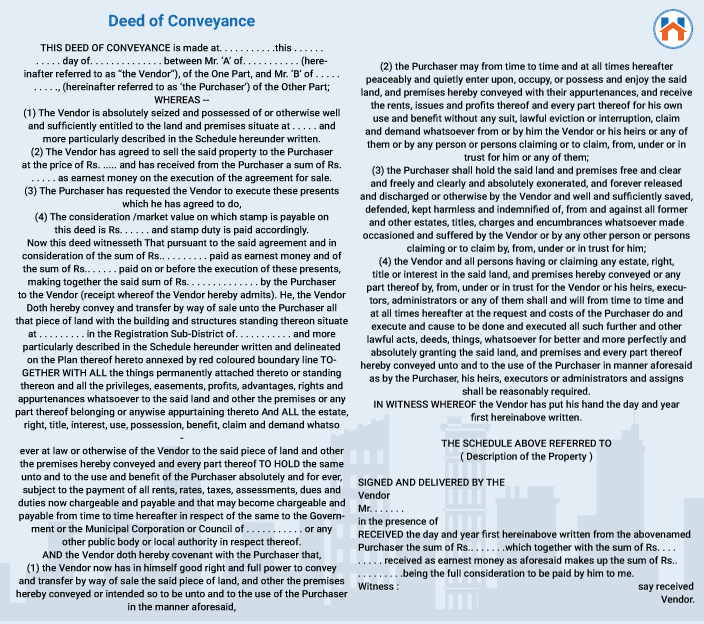
Also, check out this article: Share Certificate in Housing Society & Its Importance.
FAQs
1. What Is a Conveyance Deed?
A conveyance deed is an important document for transferring the ownership of a property. Registration of the conveyance deed legally validates the transfer of the property.
2. Why is a conveyance deed important?
The conveyance deed is important as it indicates the ownership of the property and can be produced as legal proof in case of disputes.
3. What are the types of conveyance deed?
The conveyance deed can be classified based on the nature of the ownership to be transferred. A conveyance deed can be done for freehold property, leasehold property, subject to a mortgage, or a gift deed.
4. What is the difference between a Conveyance Deed and the Sales Deed?
A sales deed is the type of conveyance deed that is prepared and executed while selling the property. The sales deed gives complete ownership of the property to the buyer.
5. How to register the conveyance deed on the property being bought?
You can register the conveyance deed for the property at the sub-registrar office by paying the applicable stamp duty and the registration charges.
6. What is another name for a conveyance deed?
A Conveyance Deed is also known as a ???Property Transfer Deed???, ???Sale Deed??? (if there is a monetary consideration involved), ???Gift Deed??? (if it is a gift without monetary consideration), ???Exchange Deed??? and ???Lease Deed???.