Buying a plot offers impressive returns as compared to residential or commercial properties. Provided that there is careful consideration of the important factors that govern the property appreciation of the land. Well-located plots in high-growth infrastructure corridors have historically recorded strong appreciation. However, returns vary depending on location, infrastructure development, legal approvals, market demand, and holding period.
However, there are certain challenges in plot investment. Some of these are longer investment time horizons, liquidity risks, title clearances, and encroachment disputes. However, such obstacles can be overcome by a positive approach to investing. It is important to be aware of all of these aspects in advance and be ready to meet them head-on later.
So, here are the top 10 things to consider before buying a plot in India in 2026:
Page Contents
- 1. Setting Up An Investment Strategy
- 2. Selecting the Type Of Land
- 3. Benefits Of Investments in Plots
- 4. Locality Analysis
- 5. Land Evaluation
- 6. Consider The Risk Involved in Buying A Plot
- 7. Important Documents To Check Before Buying A Plot In India
- 8. Loans For Buying A Plot In India
- 9. Computation Of The Capital Gain on Land Properties
- 10. Step-Wise Process For Buying a Plot in 2026
- FAQs
1. Setting Up An Investment Strategy

Before buying the plot, you must have a strategic aim for the investment. Owning land allows you to have multiple options for monetization. You must first explore all the possibilities and choose what works best within the given factors.
Note:
Homebazaar serves homebuyers searching for plots in India with end-to-end services, from site visits and lower-interest home loans to property registration guidance. We provide the best price options & offers for 1 to 4 BHK RERA-registered flats, plots, villas & penthouse properties in India. To begin a smooth homebuying journey with us, fill out the form mentioned below or on the right side.
Various Options After Buying Land:
|
Buying Land and Re-Selling |
Here you can buy land at a price lower than the market price and sell at a competitive price to get returns within a short period of time. |
|
Buying Land, Holding For Appreciation and Selling |
In this case, you buy land, hold for property price appreciation and then sell at higher rates. For this, the holding period could be more than 10-20 years. |
|
Buying Land, Developing, Selling |
In this case, you can buy land and develop residential or commercial property. After the construction, you sell the entire property and get the profit. |
|
Buying Land, Developing and Renting?? |
In this case, you buy land, develop a commercial or residential property and rent it out. This ensures continuous cash flows and keeps the ownership with you.???? |
|
Buying Land, Cultivating and Holding |
This is purely for agricultural use. You buy the land and cultivate the crop or use it for other allied farming means.?? |
Now, every type of land investment mentioned above has different profit capabilities. To know what???s best for you should consider three main factors while choosing the best option.
- Total Capital Investment Required
- The Investment Horizon
- Your End Investment Goal
For example, let???s compare the two plot investment options. The first is buying land and reselling it without any construction. Second, you buy land, construct a residential or commercial property and then sell it. The first option is much simpler and involves less effort and comparatively lower investment horizons but gives you lower returns. On the other hand, buying, constructing, and reselling have high to moderate risks and longer-term horizons, but give impressive returns.
Therefore, an ideal approach is to align your land investment goals with your investment capacity and the involved risks.
2. Selecting the Type Of Land
The land can be categorized as Agricultural or Non-Agricultural Land. To use the land for the Non-Agricultural purpose such as building Residential, Commercial, or Industrial there should be a Change of Land Use Clearance (CLU).
Let???s compare the Agricultural and Non-Agricultural Land:
|
Agricultural Lands |
Non-Agricultural Lands |
|
The Agricultural Land investment is done for two main reasons-?? Holding, cultivating, and getting Profits By reselling. |
The Non-Agricultural Lands include construction for Residential, Commercial, and Industrial purposes.?? |
|
Agricultural lands in remote areas have a very steady rate of price appreciation. |
The residential, commercial, and industrial lands have a higher chance of higher property price appreciation. |
|
There are no tax concessions applicable to the loans applied for buying Agricultural Lands.?? |
There are tax concessions applicable to loans applied for buying the land and constructing on the Non-agricultural lands.?? |
|
The Floor Space Index criteria are not applicable. |
The Floor Space Index needs to be considered before buying and constructing properties under the Non-Agricultural Lands.?? |
You can buy agricultural land and later convert it into Non- Agricultural land by taking the permissions through CLU. However, the process of obtaining the CLU can take a long time and may involve legalities. Therefore, it is always beneficial to have the CLU ready while buying the plot.
Updated CLU Timelines (2026):
- Karnataka: 30-90 days under Sakala scheme; BDA/BMRDA cases take 6-9 months.
- Haryana: 60-90 days standard; 30-45 days in fast-track industrial zones.
- Punjab/UP: 23-30 days for clean cases in conforming zones.
- Delhi: Several weeks to months via DDA-MCD route
Floor Space Index:
The Floor Space Index (FSI), also known as Floor Area Ratio (FAR) in cities like Delhi and Gurgaon, has great significance in residential as well as commercial plots. It indicates the amount of construction that can be done on a particular piece of land, and it’s set by the Municipal Corporation or the regional development authority ??? so it varies not just city to city, but locality to locality.
Here’s an example that shows the significance of FSI: if the FSI for a certain region is 2, then for 1,000 sq ft of residential plot, you can construct a house/building with a total usable area of 2 ?? 1,000 sq ft, i.e., 2,000 sq ft.
The FSI limits are being continuously updated for 2026, such as an additional 4% of area being reckoned as recreational amenities such as a gymnasium and clubhouse as an FSI-free incentive in Mumbai, 2026; Base FSI in Bangalore has been increased to 3.25 for large residential plots and up to 4.0 for large commercial plots as per plot size and road access for the year 2026. Therefore, it is crucial to verify the current FSI of the region in which you wish to invest, as the FSI may have been adjusted by the municipality, and it could have a significant impact on the development potential of the plot ??? and its resale potential.
3. Benefits Of Investments in Plots
Higher returns, flexibility, and low taxes are some of the benefits of buying plots.
- Investment in the Plots Give Higher Returns for long-term horizons.
- Buying land gives you flexibility in utilizing the space as per the specific investment goals.
- Commercial, residential, or industrial properties can be built and sold, or rented out.
- The economic and commercial corridors can give higher returns.
- Lower Applicable Property Taxes.
- Almost No Maintenance Cost.
However, to realise these benefits fully, all the real estate investment factors should be considered. This includes doing a complete analysis of the locations, upcoming infrastructure projects, connectivity, and market price trends, etc.
Major Infrastructure Projects Completing in 2026:
- Delhi-Mumbai Expressway (1,362 km) ??? November 2026
- Bengaluru-Chennai Expressway ??? June 2026
- Delhi-Dehradun Expressway ??? January 2026
- Ganga Expressway (UP) ??? 2026-27 phased completion
- Noida International Airport ??? 2026
- Mumbai-Pune Missing Link ??? 2026
- Lucknow-Kanpur Expressway ??? 2026
These corridors are expected to drive 20-35% appreciation in connected regions over 3-5 years.
4. Locality Analysis

The locality plays an important role in the property price appreciation of the land. Buying plots in a region where there is complete scope for future development always proves to be a good investment. Therefore, it is essential to give utmost importance to the Locality while buying a plot in India.
So, here are some of the main characteristics of the ideal locality for buying a plot In India-
- Easy access to essential facilities: transportation, water, and electricity.
- Proximity to important commercial and residential locations.
- Positive economic and social growth of the region.
- Impressive upcoming infrastructure projects that boost the overall development of the locality.
- Robust connectivity options to access the developed markets.
Location viability is important for better Returns on the real estate investment. Moreover, the right location from the investment standpoint is the one where there is huge scope for development.
Investments in the already developed or established localities either pick out or remain constant. Therefore, while investing in Plots always consider the locations which are developing or at the earliest phase of the development. This will allow you to buy the plots at a comparatively lower price and with upcoming developments, the prices will appreciate.
In the case of investing in agricultural land, the consideration for the locality might be slightly different. Since the agricultural land is in Tier I and Tier II cities, the consideration of the basic facilities such as water, electricity, and transportation might be sufficient. Therefore, the extent to which you consider the various points completely depends on the type of land you are buying and the end goal of your investment.
5. Land Evaluation

Land evaluation is necessary for two reasons. First, it gives clarity on the actual area and the total value of the property. Second, it gives a reference to project the returns on the real estate investment.
The property can be evaluated by methods such as-
Comparative Analysis
In a comparative method, the evaluation of the property is done by comparison. For this, the recent plot deals in the surrounding regions are considered. On the basis of this data, you can get the precise value of the particular property. Here, you need to compare the property with the executed property transactions in the vicinity. There might be minor variations in the land size, features, and other qualities. Comparative analysis is considered one of the simplest and most precise methods for Land Evaluation.
However, the challenge in this method of analysis is the availability of sufficient information. In cases where there are very limited deals, this method is less effective. In such a case, you must seek assistance from a real estate expert.
Extraction Method
In this method, the total value of land is extracted from the developed property (Constructed/Built-up) in the vicinity. However, in this method, the value of the depreciation of built-up property needs to be considered; therefore, this method is usually used for newly built properties.
Development Method
In the development method, the complete potential of the land is considered. For this, important factors such as Location, Use, FSI, and Features of the land are taken into account. Moreover, upcoming commercial and industrial developments are considered and the value is projected accordingly.
The Development Method is beneficial as it gives you the actual value of the property. Therefore, from the investment standpoint, it is always better to have the plot value on the basis of the Development Method.
Allocation Method
This method is suitable where the built-up property sales are high enough to provide sufficient data for the land evaluation. There is a relation between the total property built on the land and the value of the land. By analyzing several properties and their relationship with the land, you can calculate the approximate value for the particular land in the region.
Belting Method
In this method, the value of the Land is calculated by considering the distance from the main road. For this, the plot is divided into a series of belts, and according to the distance from the main road, the total value is calculated.
6. Consider The Risk Involved in Buying A Plot
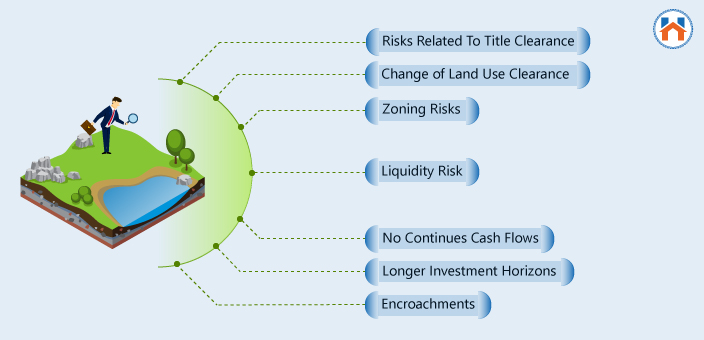
The investments in plots need more finance and a longer investment horizon. Therefore, it is important to consider all the risks involved in buying a plot. These risk factors can greatly impact the investment prospects.
The following are the important risk factors involved in buying a plot:
Risks Related To Title Clearance??
It is important that the seller of the land has complete ownership of the land. In many cases, the complexities of the title clearance cause disputes in property transactions. To avoid such situations, it is necessary to check the title clearance with due diligence.
2026 Enhanced Due Diligence:
- Verify 30-year title chain (not just 13 years)
- Check for family succession disputes (especially inherited land)
- Confirm no pending litigation on state e-Court portals
- Verify land acquisition notices (NHAI, railway, defence lands)
- Check revenue records on Bhulekh/Bhoomi portals
Change of Land Use Clearance
To utilize the agricultural land for commercial or residential purposes, there has to be a valid Change of Land Use Clearance. The process of changing the Land Use Clearance from agricultural to commercial or residential use takes time and effort. Therefore, it is beneficial to have all the Change of Land Use Clearance already in place at the time of buying land.
Updated CLU Timelines by State (2026):
|
State |
Standard Timeline |
Fast-Track (Industrial) |
Key Authority |
|
Karnataka |
30-90 days (Sakala) |
15-30 days |
BDA/BMRDA/DC |
|
Haryana |
60-90 days |
30-45 days |
DTCP |
|
Punjab/UP |
23-30 days |
15-20 days |
LDA/NOIDA |
|
Delhi |
4-6 months |
2-3 months |
DDA-MCD |
|
Maharashtra |
3-6 months |
2-3 months |
MIDC/Collector |
|
Telangana |
45-60 days |
30 days |
HMDA/DTCP |
Zoning Risks
According to the master plan of the regional authority, certain plots may come under the reserved zones. These plots may not be used for any agricultural, residential, or commercial purpose.
2026 Zoning Check Tools:
- Local development authority master plan portals (DDA, BDA, HUDA, etc.)
- RERA state portal for approved layouts
- Municipal corporation zoning maps
- Environmental clearance status (for ecologically sensitive zones)
Liquidity Risk
Investment in the plots has liquidity risks. Meaning, it restricts you from quickly cashing in the investments. The investment in plots should be done by considering the longer investment horizons.
2026 Market Reality:
- Average resale time for plots: 6-18 months in normal market conditions
- Tier-2/3 cities: 12-24 months resale time
- Expressway-adjacent plots: 3-9 months (faster due to high demand)
No Continuous Cash Flows
In the case of investment in land, there is no rental income or continuous income. The only way to get returns is to hold the property, wait for appreciation, and sell it at the right time. So, by considering the longer investment horizons, the finances should be managed accordingly.
Mitigation Strategy (2026):
- Consider lease-out for farming (agricultural land)
- Explore temporary commercial use (parking, storage, events)
- Plan phased development to generate partial rental income
Longer Investment Horizons
For better returns, investment in plots needs longer Horizons. Buyers need to wait for several years till he gets the right target appreciation. The property price appreciation depends primarily on regional development, infrastructure projects, and so on. This can take considerable time, resulting in longer investment horizons.
2026 Appreciation Expectations:
|
Investment Horizon |
Expected Returns |
Best Locations |
|
Short term (1-3 years) |
8-12% |
Metro-adjacent, expressway nodes |
|
Medium term (5-7 years) |
15-25% |
Tier-2 CER cities, airport corridors |
|
Long term (10+ years) |
30-50%+ |
Industrial corridors, Tier-3 growth centers |
Encroachments
Encroachment and the disputes related to it are frequent in the case of land properties. This is especially applicable to open lands that do not have any construction or regular use.
2026 Prevention Measures:
- Use GPS to set up boundary markers
- Visit site quarterly with photos and/or video;
- Have a licensed surveyor do a boundary survey
- Look for encroachment notices on municipal websites
- Fencing and security for high-value plots to consider.
7. Important Documents To Check Before Buying A Plot In India
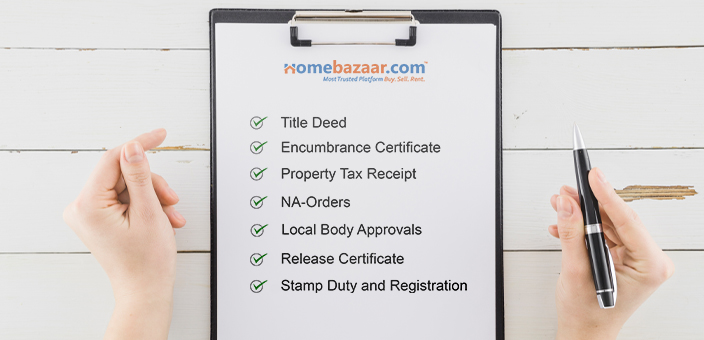
Title Deed
Title Deed indicates the legal ownership of the land. It is one of the important documents that you need to check while buying a plot. Also, duly check whether the title deed is stamped and registered with the registrar.
2026 Updates:
- Verify title on state e-Registration portals (Kaveri, Dharani, Bhulekh)
- Check for digital signatures on registered deeds (mandatory in most states)
- Confirm 30-year traceability (enhanced due to fraud prevention norms)
Encumbrance Certificate
Encumbrance Certificate indicates that the land is free from legal as well as financial liabilities. Encumbrance Certificate shows the previous property transactions. If there are no encumbrances, Form 15 is issued, whereas in case of encumbrances, Form 16 is issued.
It is a mandatory document for real estate transactions. It is extremely important in the plot buying process as it gives a clear idea of the litigation related to the plot.
2026 Online EC Application Portals:
- Karnataka: Kaveri Online Services
- Telangana: Dharani Portal
- Tamil Nadu: TNREGINET
- Maharashtra: Mahabhulekh
- UP: Bhulekh UP
- Delhi: Delhi e-District
Note: EC validity is typically 13 years, but for enhanced due diligence, request a 30-year EC for high-value plots.
Check Out: Kaveri Online Services: How To Apply For Encumbrance Certificate Online????
Property Tax Receipt
Checking the Tax Receipts confirms the ownership of the property as well as gives clarity if there are any tax dues on the land property.
2026 Property Tax Trends:
- Most states now offer online payment with instant receipts
- Property tax rates range from 0.1-0.3% of assessed value annually
- Check for outstanding dues on municipal corporation portals
NA Orders (Non-Agricultural Orders)
Without NA orders, the agricultural land cannot be used for commercial or residential purposes. RERA has made it mandatory for the land property seller to disclose the NA order if the land is used for residential or commercial purposes.
2026 RERA Compliance:
- The developments in Plotted categories should be uploaded on the RERA portal with the name of the NA order.
- Check the authenticity of the NA order on the portal of the State Revenue Department.
- See if there are any conditions/restrictions stated within the NA order.
Local Body Approvals
It is important that the local government body gives approval to the plot. The approval suggests that the plot does not fall under the government master plans and can be owned privately.
2026 Approvals to Verify:
- Layout approval from local development authority (BDA, DDA, HUDA, etc.)
- Building plan sanctions (if applicable)
- Environmental clearance (for large plots >10,000 sqm)
- NOC from pollution control board (if industrial zone)
Release Certificate
This certificate gives confirmation that the property is free from bank liabilities. A release certificate is important as it gives assurance to the buyers that there are no dues pending.
2026 Digital Verification:
- Request a CERSAI (Central Registry of Securitisation Asset Reconstruction and Security Interest) check
- Verify on the state land records portal for any mortgage entries
- Get a bank NOC on stamped paper if the plot was previously mortgaged
Stamp Duty and Registration
The previous owner of the property must have done all the formalities related to the Stamp Duty and Registration. Ensure that the title deed is registered at the registrar.
2026 Stamp Duty Rates (Major States):
|
State |
Stamp Duty |
Registration |
Women Concession |
|
Maharashtra (Mumbai) |
6% (urban) / 5% (rural) |
1% (capped at ???30,000) |
3% (women) |
|
Karnataka (Bangalore) |
5% (above ???45L) |
1% |
3% |
|
Delhi |
6% (male) / 4% (female) |
1% + ???100 |
4% (women) |
|
Tamil Nadu |
7% (urban) |
4% |
No differential |
|
Telangana (Hyderabad) |
4% |
0.5% |
3% |
|
Gujarat |
4.9% |
1% |
3.9% |
|
Uttar Pradesh (Noida) |
7% (urban) / 6% (up to ???1Cr) |
1% |
1% + 2% (senior) |
|
Haryana (Gurgaon) |
7% (urban) |
1% |
5% (women) |
|
Kerala |
8% |
2% |
No concession |
|
Rajasthan |
6% |
1% |
5% (women) |
Total Cost Budget: Plan for 8-15% of plot value for stamp duty, registration, and legal fees.
8. Loans For Buying A Plot In India
Banks and financial institutions sanction the Loan for buying the plots. Land Loan and Land plus construction loans are the two loan options you get. Generally, the maximum repayment tenure for the plot loans is 25 years.??
However, the land loan is sanctioned only within the municipal limits or outside the municipal limits if the allotment is done by the regional development authority.
2026 Plot Loan Landscape:
|
Lender |
Interest Rate (2026) |
Max LTV |
Tenure |
Special Features |
|
SBI |
9.50% onwards |
70-75% |
15-20 years |
Govt. bank, lower processing fees |
|
HDFC Bank |
10.50-12.50% |
70% |
15 years |
Strict documentation, premium locations |
|
ICICI Bank |
10.75-12.75% |
70% |
15 years |
Quick processing, metro focus |
|
Kotak Mahindra |
8.75% onwards |
70-75% |
15-20 years |
Competitive rates, digital approval |
|
Federal Bank |
8.80% onwards |
75% |
20 years |
Lower processing fees |
|
Bank of Maharashtra |
8.35% onwards |
70% |
15-20 years |
Best for salaried borrowers |
|
LIC Housing Finance |
9.50-11.55% |
70% |
15 years |
Flexible for self-employed |
|
PNB Housing |
9.50% onwards |
70% |
15-20 years |
Good for Tier-2 cities |
Average Plot Loan Rates (2026): 9.50% – 12.50% p.a. (slightly higher than home loans)
Important Points For Loans For Buying a Plot:
- The interest rates for plot loans are almost the same as those for home loans. However, some banks and financial institutions set higher interest rates for Land Loans. 2026 Reality: Plot loans typically range from 9.50-12.50%, while home loans are 8.50-10.50%.
- The LTV (Loan-to-Value Ratio) is considerably lower, at 70% of the property value. Some lenders offer up to 75-80% for approved layouts in prime locations.
- The Loan Tenure for buying the plot is lower. Maximum tenure is 15-20 years for plot loans (vs. 25-30 years for home loans).
- Tax benefits on principal to be paid in a year under Section 80C and tax benefits on the annual interest payable as per Section 24(b) will only be applicable if the house is built on the land/plot. Pure plot loans are not eligible for tax exemption.
Key Point: If you choose the new tax regime (default for most taxpayers), you will not receive any home loan tax benefits. Deduction under Section 80C and 24(b) is given in the old regime only.
Plot Loan Tax Strategy (2026):
- Begin building within 3 years of the purchase of the property to receive tax benefits.
- Once construction begins, the loan converts to a home loan and tax benefits apply.
- Under the old regime: ???1.5 lakh (80C) + ???2 lakh (24b) = ???3.5 lakh total deduction per year.
- There is a 2-4% prepayment penalty applicable on the prepayment of the loan. There are some banks (such as SBI, Kotak) that have no prepayment charges for floating-rate loans. Never sign without confirmation.
2026 Additional Plot Loan Considerations:
- Processing fees: 0.5-1% of loan amount (???5,000-???25,000 typical)
- Prepayment: Zero charges on floating-rate loans (most banks)
- Documentation: Stricter for plot loans (RERA approval, NA order, layout sanction mandatory)
- Approval time: 7-15 days (vs. 3-7 days for home loans)
- Success rate: 60-75% (lower than home loans due to higher risk)
Some of The Important Tips For Buying A Plot
Get The Construction Loan
The construction loan allows you to get the loan for the land as well as the construction. Construction loans are considered easier to obtain and help you realize the property price appreciation fully.??
2026 Plot + Construction Loan Advantages:
|
Feature |
Plot-Only Loan |
Plot + Construction Loan |
|
Interest Rate |
9.50-12.50% |
8.50-11.50% (lower) |
|
LTV Ratio |
70-75% |
75-80% (higher) |
|
Tenure |
15-20 years |
20-30 years |
|
Tax Benefits |
None |
Available under 80C + 24(b) |
|
Approval Time |
7-15 days |
10-20 days |
|
Best For |
Land banking |
Immediate construction |
Large Down Payments
Making a higher Down payment increases the chances of getting the land loan approved. This also ensures lower EMIs and the net applicable interest is comparatively lower. Generally, banks or financial institutions need at least a 20-30% down payment for the land.??
Great Credit Score
Having a credit score between 700-900 is essential to obtain land loans. A credit score is a number between 300-900 which suggests the repayment capacity of the borrower. It takes into account the entire repayment history of the borrower and accordingly gives indications to the banks or the financial institutions on sanctioning the land loans.
Income and Debt Ratio
As a thumb rule, the EMI should not be more than 40% of your monthly income. Banks also consider this while lending the loans. Therefore, for a better repayment structure, you should keep the EMISs below 40% of monthly income.??
9. Computation Of The Capital Gain on Land Properties
The investment in land property is a longer-term investment, as considerable time is typically required for the land to appreciate.
Holding period for long-term status: In case of immovable property like land, the holding period should be more than 24 months to be considered long-term, which has been reduced from the earlier period of 36 months in Budget 2024 and continues for FY 2026-27.
LTCG tax rate: Property acquired on or after July 23, 2024, will be taxed at 12.5% without indexation for long-term capital gains
For property acquired before July 23, 2024 and sold on or after that date, resident individuals and HUFs get a one-time choice between paying 12.5% without indexation or 20% with indexation ??? whichever works out lower for that specific sale. Budget 2026 made no changes to this framework, so it continues into FY 2026-27.??
The capital gains on land properties still depend on the same core factors:
- Purchase Price
- Selling Price
- The Holding Period
- Land Valuation
10. Step-Wise Process For Buying a Plot in 2026
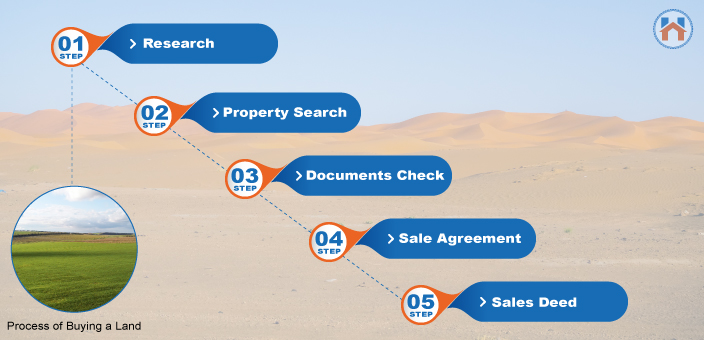
Step 1: Research
In this stage, you consider all the aspects involved in the investment in the plot. This involves considering the following important factors:
- Market Price Trends
- Other Real Estate Deals in The Vicinity
- Locality Research
- Growth Prospects
- Possible Returns On Investment, etc.
Step 2: Property Search
You can find property-related information through Brokers or Real Estate Portals. Ensure that the information you are referring to is valid and make decisions accordingly. The best way to compare properties online is to use the real estate portal that has the latest digital features and provides no brokerage policy to property buyers.
2026 Best Real Estate Portals:
- NoBroker: Zero brokerage, verified listings
- PropTiger: Price trends, RERA data integration
- MagicBricks: AI-powered recommendations
- 99acres: Large inventory, developer projects
- Housing.com: Virtual tours, locality insights
While searching for a property, buyers should consider all the analyses done in the first research stage.
Red Flags to Avoid (2026):
- Listings without RERA registration (for 500+ sqm or 8+ plots)
- Prices significantly below market rate (potential fraud)
- Sellers unwilling to share title documents
- No approved layout plan from local authority
- Agricultural land without NA order or CLU clearance
Step 3: Documents Check
Checking the documents is crucial while buying the land. It involves significant financial commitments from the buyer for longer investment periods. So, before finalizing the land property deal, check all the essential documents, which include:
2026 Document Checklist:
|
Document |
Purpose |
Where to Verify |
|
Title Deed |
Proof of ownership |
Sub-registrar office, e-District portal |
|
Encumbrance Certificate (EC) |
No legal/financial dues |
Kaveri, Dharani, TNREGINET (30-year EC recommended) |
|
Property Tax Receipts |
No outstanding dues |
Municipal corporation portal |
|
NA Order / CLU Certificate |
Non-agricultural use approval |
Revenue department, BDA/DDA portal |
|
Approved Layout Plan |
Authority sanction |
Local development authority (BDA, HUDA, DTCP) |
|
RERA Registration |
Compliance (if applicable) |
State RERA portal |
|
Release Certificate |
No bank mortgage |
CERSAI, bank NOC |
|
Land Use Certificate |
Zoning compliance |
Local planning authority |
|
Survey Map / FMB |
Boundary verification |
Revenue survey department |
|
Sale Agreement Draft |
Terms & conditions |
Legal verification recommended |
Pro Tip: Hire a property lawyer for document verification (cost: 0.5-1% of plot value). This prevents costly disputes later.
Step 4: Sale Agreement
After the negotiation, the sales agreement is prepared. The buyer has to pay an advance of 10% of the agreed price. The sales agreement has all the details related to the terms and conditions, agreed price, default penalties, and important payment terms.
|
Clause |
Recommended Terms |
|
Advance Payment |
10-15% (maximum 10% as per RERA for plotted developments) |
|
Payment Schedule |
Linked to milestones (e.g., 20% on EC clearance, 30% on loan approval) |
|
Default Penalty |
2-3% per month for buyer delay; 18% interest for seller delay |
|
Possession Date |
Clearly specified with extension clauses |
|
Title Warranty |
Seller guarantees clear, marketable title |
|
Encumbrance Disclosure |
Seller must disclose all encumbrances in writing |
|
Dispute Resolution |
Arbitration clause (faster than court) |
Stamp Duty on Sale Agreement: 0.1-0.5% of agreement value (varies by state)
Note: For RERA-registered plotted developments, the Agreement for Sale must be registered on the state RERA portal within 30 days of signing.
Step 5: Sales Deed
The buyer has to make the complete payment, usually within 2-3 months. The sales deeds need to be registered at the sub-registrar office along with stamp duty and registration charges.
2026 Registration Process:
- Pay Stamp Duty: Online via state e-Stamp portal (valid for 6 months)
- Schedule Appointment: Sub-registrar office (many states now offer online booking)
- Document Submission:
- Sale deed (on stamp paper)
- Title deed, EC, property tax receipts
- PAN cards of buyer & seller
- Aadhaar cards (mandatory in most states)
- Passport photos
- NOC from society/authority (if applicable)
- Biometric Verification: Both parties present (or via PoA)
- Payment: Registration fee (1-3% of property value)
- Registration Certificate: Issued within 7-15 days
2026 Digital Initiatives:
- e-Registration: Available in Karnataka, Telangana, Maharashtra, Delhi
- Video Registration: Some states allow remote registration for NRIs
- e-Stamp: Online stamp duty payment (no physical stamp paper needed)
Total Cost Breakdown (2026):
|
Cost Component |
Percentage of Plot Value |
|
Stamp Duty |
4-8% (varies by state) |
|
Registration Charges |
0.5-3% |
|
Legal Fees |
0.5-1% |
|
Documentation |
0.2-0.5% |
|
Total |
5.2-12.5% |
FAQs
|
1. Why is investing in a Plot in India a good idea? Investing in a plot offers benefits such as higher returns, flexibility, lower maintenance costs, etc. However, a successful investment in plots comes down to the important factors responsible for property appreciation, which include locality, growth of the region, and commercial & social development. |
|
2. What Is Floor Space Index (FSI)? The Floor Space Index indicates the amount of construction that can be done on a particular land. The FSI index is set by the Municipal Corporation or the regional development authority.?? |
|
3. What Are the Different Methods Used for Land Evaluation? Various methods used for land evaluation are: Comparative Method, Extraction Method, Development Method, Allocation Method ad Belting Method.?? |
|
4. What Are Important Documents To Check Before Buying a Plot In India? Title Deed, Encumbrance Certificate, Property Tax Receipt, NA Orders, Local Body Approvals, Release Certificate, Stamp Duty, and Registration. |