The advent of the RERA Act in 2016 streamlined the real estate market. This has mainly benefited property buyers in a number of ways.
But let???s first understand why there was a need for the centralized Real Estate Regulatory Authority (RERA). And whether it has been effective in safeguarding the interests of homebuyers.
Before RERA, the Real Estate market was unorganized. Meaning, there was no authority that governed the different stakeholders in the real estate sector. The absence of a registry and regulations for the builders, developers, agents, and projects often led to unprofessional practices and fraud. Delays in project completions, misleading promotions, and non-transparency in the cost structure were some of the prevailing problems before the RERA Act.
And above all, there was no robust framework for homebuyers to register and resolve their complaints.
So to protect homebuyers and ensure professional practices in the real estate sector, the Real Estate Regulatory Authority was established under the RERA Act 2016. Understanding some of the key points of this Act is important for you as a homebuyer. This will help you to be more alert and make smart decisions in the homebuying process.
Page Contents
- What Is RERA?
- Responsibilities Of The Builder Under RERA
- ??List of Responsibilities of the Builder or Promoter Under RERA
- RERA Registration
- RERA Details & QR Code Mandate
- Providing Important Information ??
- Get the Approvals from the Authorities
- Maintenance
- Executing the Conveyance Deed
- 10% Advance Payments
- Escrow Account Audits
- Adherence to the Sanctioned Plans
- Alterations and Structural Changes
- Repairs and Maintenance
- No Transfer of Liabilities
- Insurance of the Real Estate Project
- Transfer of the Title
- Refund Amount and Compensation
- Important Things Buyers Should Check As Per RERA
- Rights Of The Homebuyers Under RERA??
- The Benefits Of RERA For Homebuyers
- Responsibility Of the Home Buyers Under RERA??
- Penalties For Builder Under RERA
- Penalties for Homebuyers under RERA
- Cancellation and Refund under RERA
- How Homebuyers Can File a Complaint Under RERA?
What Is RERA?
The Real Estate Regulation and Development Act 2016 established the Real Estate Regulatory Authority to regulate and promote efficient & transparent real estate transactions.
RERA protects the interests of the property buyers by establishing a speedy dispute redressal mechanism and ensuring that the sale of a plot, apartment, building, real estate projects, etc are done according to the standard centralized guidelines.
It clearly outlines the responsibilities of the Real Estate Promoters (Builders or Developers), Real Estate Agents, and Buyers. Non-compliance with any of the provisions can be subject to the stringent penalties stated in the RERA Act.
The rules and regulations under the RERA Act 2016 can be regulated by the respective state governments. Currently, 35 States and Union Territories have notified the RERA guidelines, with over 1.51 lakh (151,000+) projects registered nationwide. Since its enactment, Real Estate Regulatory Authorities across the country have successfully addressed and resolved more than 1.47 lakh (147,000+) complaints.
The Real Estate Regulatory Authority has proved beneficial for homebuyers because of its structured and assuring framework.
Responsibilities Of The Builder Under RERA

Without RERA registration, the builder or promoter cannot sell, promote, or book any apartment or building. Therefore, the prime responsibility of the builder or promoter is to have an official RERA registration.
Also, for every real estate project, the promoter has to make an application to the RERA with the important details and documentation regarding the project.
??List of Responsibilities of the Builder or Promoter Under RERA
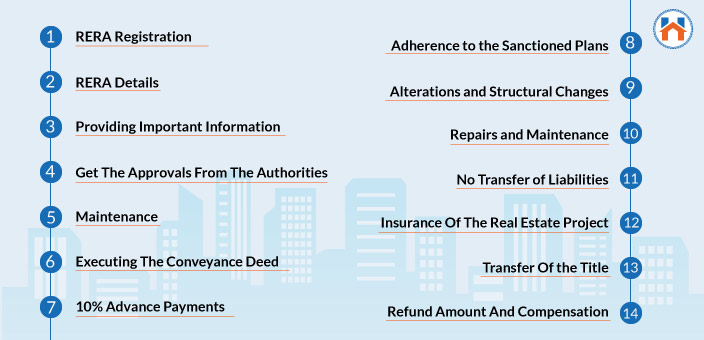
RERA Registration
It is compulsory for the promoter to have RERA registration. Except where the area of the proposed land of the project is not more than 500 sq meters or the number of units/apartments is less than 8.
RERA Details & QR Code Mandate
The promoter should have a webpage on the official RERA website with important project details. Several State RERA authorities, including MahaRERA, require promoters to display a scannable QR code on advertisements and promotional material. Buyers can scan the code to verify project details through the respective State RERA portal.
Providing Important Information ??
At the time of booking, the Builder should issue an allotment letter to the buyers with sanctioned building plans, construction time schedules, and infrastructure details.
Get the Approvals from the Authorities
The promoter is responsible for getting the completion and the occupancy certificate from the local governing bodies.
Maintenance
It is the responsibility of the developer to provide essential services until the association of allottees takes over, including paying property taxes and utility charges until physical possession is handed over.
Executing the Conveyance Deed
Executing the registration of the conveyance deed in favor of allottees and facilitating the formation of the association of allottees or cooperative society as applicable under law.
10% Advance Payments
The promoter should not accept advance payments of more than 10% of the cost of the property without entering into a registered agreement for sale.
Escrow Account Audits
Promoters must deposit 70% of buyer collections into a dedicated separate bank account. Developers are required to submit periodic financial and construction progress disclosures certified by engineers, architects, and chartered accountants as prescribed by the respective State RERA authority.
Adherence to the Sanctioned Plans
The project should be completed within a given time frame by adhering to the sanctioned plans approved by local authorities.
Alterations and Structural Changes
The promoters should not make any structural alterations without written consent from at least two-thirds ($2/3$) of the project’s allottees.
Repairs and Maintenance
Promoters should make necessary repairs in case of structural defects or poor construction quality within thirty days free of cost. Provided that the property buyers notify the builder about the defects within the first five years after receiving possession.
No Transfer of Liabilities
The promoter cannot transfer majority development rights to a third party without prior consent from two-thirds of the allottees and official RERA approval.
Insurance of the Real Estate Project
The promoter should obtain all necessary project insurance policies and transfer them to the homebuyers’ association upon completion.
Transfer of the Title
The promoters should execute the transfer of the registered conveyance deed in favor of property buyers along with handing over common area plans after obtaining the occupancy certificate.
Refund Amount and Compensation
If the builder fails to deliver the project as per specifications and timeline, the promoter must allow buyers to withdraw from the project, refund the full amount paid, and pay compensation along with the refund.
Important Things Buyers Should Check As Per RERA
| Parameter | What to Check Before Purchasing |
| RERA Registration & QR Code | Verify that the project has an active RERA number and scan the QR code on advertisements to view official status. |
| Escrow Account Details | Ensure payments are deposited into the designated RERA project escrow account. |
| Carpet Area vs Super Built-up | Check the exact carpet area specified in the agreement, as property prices can only be quoted on carpet area. |
| Sanctioned Plans & OC/CC | Verify that building plans, floor layouts, and environmental approvals are uploaded and approved on the RERA portal. |
| Agent RERA ID & Certification | Confirm that your real estate agent holds a valid RERA registration number. |
Rights Of The Homebuyers Under RERA??

Get the Right Information
Under RERA, the property buyers are entitled to get information on the plans, layouts, and approval status of the project. The builder therefore should provide all the details demanded by the buyer.
Get the Schedule of the Construction
RERA empowers homebuyers to know the detailed schedule plan of the project construction. This also includes the dates for the various construction stages.
On-Time Possession
RERA gives the right to homebuyers to get possession of the house within the prescribed time. Failing which, the buyer is entitled to get compensation and refunds.
Get the Refund & Compensation
If the builder fails to deliver the project with predefined specifications and on the scheduled time, buyers can choose to cancel the contract and get a refund of the amount paid along with interest and compensation. Under RERA guidelines, the applicable interest rate payable by the developer for delays (or by the buyer for payment defaults) is standardised across states at SBI???s Highest Marginal Cost of Lending Rate (MCLR) + 2% per annum.
Documents
After the possession of the document, the property buyers should get all the important documents and plans. This includes all the approvals, NOC certificates, sales deeds, etc.
The Benefits Of RERA For Homebuyers

RERA safeguards the interests of the property buyers. It has framed its guidelines in such a way that it adds key benefits to the property buyers.
Here are some benefits RERA offers to The Home Buyers:
Accurate Information??
With RERA, the buyers get the right information to make the buying decision. This is important because, previously, the buyers were misled by fraudulent promoters. To avoid this, RERA brought strict guidelines for the builders which enable the buyers to get the right information.
Under it, important information such as property specifications, prices, terms and conditions, payment modes, building plan approvals, layouts, etc is provided to the buyers.
Transparency??
RERA has made it mandatory for the developers to disclose the carpet area to the buyers. In fact, the promoters can advertise and sell the properties only on the basis of the carpet area. This has provided great transparency to the buyers. Before RERA, the developers used to quote on the basis of Super-Built-up area. This was confusing for the buyers and had many loopholes.
By making it mandatory to disclose the carpet area, it has been ensured that buyers get what they pay for. There is no hidden factor and no fraud.
In-Time Project Completion
Before RERA, delayed projects were the biggest challenge in buying under-construction properties. Because of the delays, buyers had to bear the monetary losses.
To avoid this, it brought strict guidelines to complete the project on time.
To ensure on-time project completion, RERA has made the following guidelines.
- If the builder does not complete the project within the given timeline, then he has to pay compensation to the buyers for the delay
- The builder has to pay up to 10% of the total cost of the project as a penalty??
- Buyers can cancel the agreement if the project is getting delayed
- The builder needs to pay the refund along with interest
Cap on the Advance Payments
Before RERA, there was no specific limit on the advance payments charged by the builders. To ensure affordability to the buyers, the Real Estate Regulatory Authority imposed a cap on the advance payments collected by the builder.
According to RERA, the promoter cannot take more than a 10% advance without entering into the sales agreement.
Complaints Redressal
RERA has a fast-track dispute redressal system. In case of any dispute, buyers can appeal to the Appellate Tribunal. Then the necessary action is taken against the builder in case of breach of conduct.
The builder has to comply with the final decision taken by the tribunal and give the necessary refund and compensation to the buyer.
Quality of the Projects
Because of RERA, the quality of the real estate projects has been improved. In case of any defect or poor construction, the builder is responsible for making the necessary repairs.
Also, in the case of under-construction properties, if the buyers find the specifications are not as previously defined, then the buyers can demand compensation on the basis of what they have got.
The RERA asks the builder to recalculate the price on the basis of the actual carpet area property buyers are getting. However, if the carpet area is less than the area mentioned in the agreement, then the builder has to repay the extra amount charged. On the other hand, if the final carpet area is more, then the buyer is liable to pay the extra amount to the builder.
No Frauds
This is one of the biggest impacts of the RERA. Every builder has to register the project with RERA and display all the details on various media while selling. Also, there is no chance of hiding or spreading misleading information. If the promoter does not follow the guidelines, then penalties can be imposed on the promoter.
This has resulted in more transparency and no fraud in the real estate market. Even if cases of fraud arise, the Real Estate Regulatory Authority ensures a fast-track redressal system.
Compensation for Defaults
RERA addresses the disputes between the buyers and the builders on a fast-track basis. If the builder has defaulted, then is liable to pay compensation to the buyers.
Suppose the builder or developer delays the construction project and the buyer decides to cancel the agreement with the builder, then the builder has to pay all the amount paid by the buyer along with the applicable interest rate.
Cancellations in Case of Defaults
RERA gives the right to the buyer to cancel the contract with the builder if the builder does not follow the standard guidelines. Provided that the reasons for the withdrawal from the contract are fair.
The builder should allow the buyers to withdraw from the contract as per their wishes.
Refund Policy With Interests
In case of any default, buyers get a refund along with interest to avoid losses. This has not only safeguarded the buyers but has ensured no loss or fraud.
Responsibility Of the Home Buyers Under RERA??
RERA has also highlighted some of the key responsibilities of home buyers. The buyers should ensure that they adhere to these important guidelines for successful real estate transactions.
Timely Payments:?? The property buyers are responsible for making timely payments as per the sale agreements. The buyers should know the payment schedule and ensure the payments are made as per the stages defined in the agreement. Also, the buyers need to pay interest in case the payment gets delayed.
Formation Of The Society: Once the buyers get possession of the property, they should participate and cooperate to form an association, cooperative society, or federation.
Registration Of the Conveyance Deed: A conveyance deed is one of the most important documents in the home buying process. Therefore, the homebuyers should cooperate and participate in the registration of the conveyance deed. And should ensure that the process is completed successfully.
Penalties For Builder Under RERA

For Not Registering The Project
Under RERA, it is mandatory for the builder to register the project. Without this registration, the builder can???t promote or sell a single unit of the real estate project. If the builder does not follow the guidelines by not registering the project, a penalty of 10% of the total cost of the project may be imposed.
Further, if the builder does not pay the penalty and continues to violate the RERA provision, then he can be punishable for up to 3 years’ imprisonment. The fine can be extended beyond 10% of the total cost of the project.
Spreading False Information
RERA has strict guidelines for providing accurate information to buyers. If the builders provide any false information through advertising or any medium, they will be duly penalized. The fine can be up to 5% of the total estimated cost of the project.
Non-Compliance with RERA Orders
If the builders or developers do not follow the orders or the directions of the RERA, then the builders have to pay the fines. These penalties are up to 5% of the estimated cost of the project and continue for the period of non-compliance.
Non-Compliance with Appellate Tribunal Orders
The Appellate Tribunal gives decisions on disputes between the buyers and the promoters. If the builders do not follow the decisions and directions given by the tribunal, then he is punishable with imprisonment for three years. Moreover, a penalty of up to 10% of the estimated cost of the project is charged for the default period.
Penalties for Homebuyers under RERA
RERA also imposes penalties on the buyers if they do not comply with the guidelines. This generally includes non-payment of the total amount or the interest.
Non-Compliance with RERA Orders
If the buyer does not follow the RERA guidelines, then a penalty of 5% of the total cost of the property is imposed.?? Therefore, the buyers should ensure timely payments. If the buyer continues to default, then the penalty is applied to the entire default period.
Non-Compliance with Appellate Tribunal
As per the most recent amendment to the RERA Act, a home buyer may be obligated to pay a monetary penalty amounting to up to 10% of the cost of the property in case they fail to comply with the directions of the Appellate Tribunal. Earlier, such non-compliance was punishable with imprisonment, but this has been removed under the Jan Vishwas (Amendment of Provisions) Act, 2026.
Cancellation and Refund under RERA
A home buyer can cancel the agreement and withdraw from the contract. But provided that there is a valid reason for the cancellation.
The cancellation could be because of the default of the builder or buyer.
Let???s understand the different defaults between the builder and the buyer which can lead to the cancellation of the purchase agreement.
Builder/Developer???s Default
The buyers can withdraw from the sales agreement for the following defaults by the builder.
- The builder fails to complete the project within the given timeline
- The builder fails to provide possession of the property to the buyers
In such cases, the builder has to repay the entire amount paid by the buyers along with interest as compensation.
Moreover, for the defective land title, the builder has to pay compensation to the property buyers. Also, in case of delays in the completion of the project, the builder needs to pay interest for the delayed period.
Property Buyer???s Default
If the buyer fails to pay the amount, then the builder has the right to terminate the contract. If the payment is delayed and the builder does not cancel the allotment of the buyers, then the buyer has to pay the interest for the delayed period to the builder.
How Homebuyers Can File a Complaint Under RERA?

If the buyers want to complain against the builder, agent, or promoter, they have two options: register the complaint directly with RERA or approach Consumer Forums (such as consumer courts or NCLT). Since Consumer Forums carry large backlogs, it is recommended to register with the dedicated RERA authority.
Digital state RERA e-portals now ensure smooth handling of complaints (Form M for seeking relief/directions or Form N for compensation claims), with online document upload and virtual conciliation hearings. Buyers may also resort to appropriate legal remedies in case any project is found to be unregistered or in violation of the provisions, subject to the jurisdiction of the concerned authority.
Under RERA, an Appellate Tribunal (REAT) is set up to hear appeals against the orders of the Real Estate Authority or the Adjudicating Officer.
Can the applicant have a legal representative or a lawyer in the Appellate Tribunal?
Yes. An applicant can appear in person or choose professional representatives such as legal practitioners, Chartered Accountants (CA), Company Secretaries (CS), or Cost Accountants before the Real Estate Authority, Adjudicating Officer, and Appellate Tribunal.
The Appellate Tribunal executes orders with all powers of a civil court. If the applicant remains unsatisfied with the decision made by the Appellate Tribunal, a further appeal can be filed before the State High Court within 60 days of communication.